
The Bangladesh Journal of Fisheries Research (BJFR) follows a structured, transparent, and ethically governed publication process to ensure the dissemination of high-quality scientific knowledge in fisheries, aquaculture, and aquatic sciences. Published by the Bangladesh Fisheries Research Institute (BFRI), the journal is committed to maintaining international standards of editorial integrity, peer review quality, and scholarly communication.
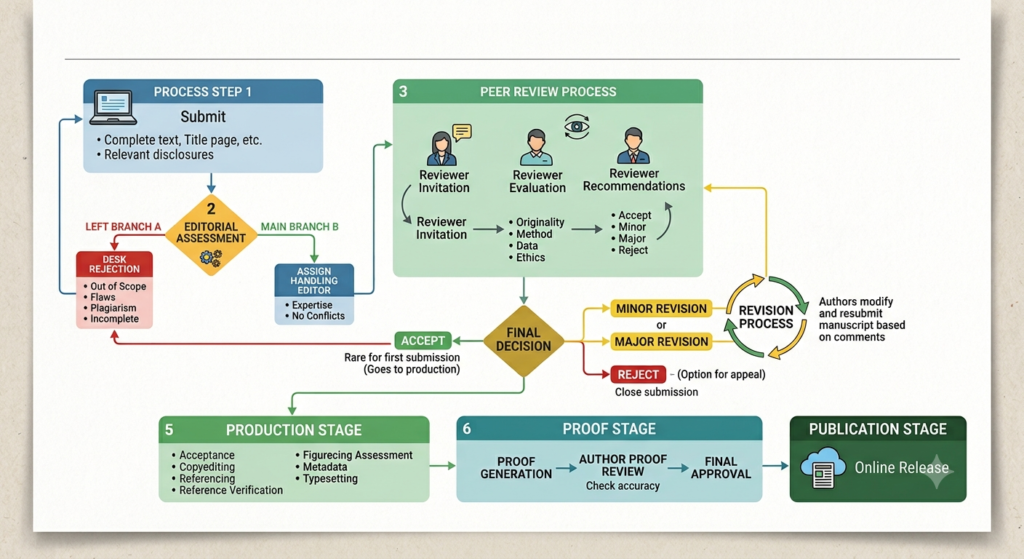
The publication process is designed to ensure that every manuscript submitted to BJFR undergoes a fair, rigorous, and timely evaluation from submission to final publication. The process integrates multiple stages, including initial editorial screening, similarity checking, peer review, author revision, editorial decision-making, production, and post-publication management. Each stage is implemented to uphold the scientific reliability, ethical compliance, and academic value of published research.
BJFR operates with full editorial independence. Editorial decisions are based solely on scientific merit, originality, methodological rigor, ethical compliance, and relevance to the scope of the journal. The publisher, Bangladesh Fisheries Research Institute (BFRI), does not interfere with editorial decisions regarding acceptance or rejection of manuscripts.
The publication process also reflects BJFR’s commitment to internationally recognized standards and best practices recommended by organizations such as the Committee on Publication Ethics (COPE), the International Committee of Medical Journal Editors (ICMJE), the Council of Science Editors (CSE), and the Directory of Open Access Journals (DOAJ). These principles ensure that the journal maintains integrity, transparency, accountability, and fairness at every stage of publication. The full manuscript lifecycle at BJFR typically includes the following stages:
- Manuscript submission by authors through the journal system
- Initial editorial assessment and administrative screening
- Similarity and ethical compliance check
- Assignment to handling editor
- Double-blind peer review process
- Editorial decision-making
- Author revision and resubmission
- Copyediting and production
- Proofreading and final approval
- Online publication and dissemination
- Post-publication monitoring and corrections (if required)
Each stage is structured to ensure that only scientifically valid, ethically sound, and methodologically robust research is published.
This publication process is closely aligned with BJFR’s broader editorial policies, including the Publication Ethics Policy, Authorship Policy, Plagiarism Policy, Peer Review Policy, Conflict of Interest Policy, and Correction and Retraction Policy. Together, these policies establish a comprehensive framework for responsible scholarly publishing.
Manuscript submission
BJFR accepts manuscripts that contribute original and significant knowledge to fisheries and aquatic sciences. All submissions must be made through the journal’s designated submission system or official editorial communication channel as specified in the Instructions for Authors.
Eligible manuscript types
The journal considers a wide range of scholarly contributions, including but not limited to:
- Original research articles presenting novel experimental, field-based, or theoretical findings
- Review articles synthesizing existing knowledge in fisheries and aquatic sciences
- Systematic reviews that follow structured and reproducible methodologies
- Meta-analyses that statistically integrate findings from multiple studies
- Short communications reporting concise but significant findings
- Technical notes describing new methods, tools, or procedures
- Perspectives or conceptual papers discussing emerging issues or theoretical advances
- Case studies with scientific or management relevance
- Letters to the Editor addressing published work or topical issues
- Editorials and invited commentaries
All submitted manuscripts must fall within the scope of fisheries, aquaculture, aquatic ecosystems, or related interdisciplinary sciences.
Submission system and process
Authors are required to submit manuscripts through the official submission channel of BJFR. Submissions must include all necessary files in a complete and organized format to facilitate editorial processing. Each submission typically includes:
- A complete manuscript file prepared according to journal formatting guidelines
- Title page with author details, affiliations, and corresponding author information
- Abstract and keywords
- Main manuscript text
- Tables and figures (submitted separately or embedded, depending on journal instructions)
- Supplementary materials, if applicable
- Cover letter outlining the significance of the work
The cover letter should briefly explain the scientific contribution of the manuscript and confirm that the submission is original, not under consideration elsewhere, and complies with all ethical requirements of the journal.
Author information and identification
Authors must provide accurate and complete information at the time of submission, including:
- Full names of all authors
- Institutional affiliations
- Corresponding author contact details
- Email addresses of all authors
- ORCID identifiers, where available
The corresponding author is responsible for communication with the journal and must ensure that all co-authors have approved the submitted version of the manuscript.
Mandatory declarations
To ensure transparency and ethical compliance, authors must provide the following declarations at the time of submission:
- Authorship contribution statement, specifying the role of each author
- Conflict of interest disclosure, identifying any financial or non-financial interests
- Funding statement, indicating sources of financial or institutional support
- Ethical approval statement, where applicable for human, animal, or environmental research
- Data availability statement, describing access to underlying research data
- Artificial intelligence disclosure, if AI tools were used in manuscript preparation
Failure to provide complete and accurate declarations may result in delays, editorial queries, or rejection prior to peer review.
Initial editorial assessment
All manuscripts submitted to the BJFR undergo an initial editorial assessment to ensure that they meet the journal’s basic requirements before entering the peer review process. This stage is essential for maintaining editorial efficiency, ensuring adherence to journal scope, and safeguarding publication ethics and scientific quality.
The initial assessment is conducted by the Editorial Office and/or the handling editor under the supervision of the Editor-in-Chief. At this stage, manuscripts may be accepted for peer review, returned to authors for correction, or rejected without external review (desk rejection), depending on compliance with journal standards.
Administrative screening
The first step of the initial assessment involves administrative screening. The Editorial Office checks whether the submission is complete and properly prepared for evaluation. This includes verification of:
- completeness of manuscript files
- presence of required sections (title, abstract, keywords, main text, references, tables, figures)
- inclusion of author information and correspondence details
- presence of required declarations (ethics, funding, conflict of interest, data availability)
- adherence to submission format and structural guidelines
Manuscripts that are incomplete or incorrectly formatted may be returned to authors for correction before further processing.
Scope assessment
Each manuscript is evaluated to determine whether it falls within the scientific scope of BJFR. The journal primarily considers research in fisheries, aquaculture, aquatic ecology, marine and freshwater biology, fish health, aquatic biotechnology, fisheries management, and related interdisciplinary fields. Manuscripts that are clearly outside the scope of the journal may be rejected at this stage without peer review. In borderline cases, the handling editor may request additional clarification from the authors or forward the manuscript for editorial consideration.
Formatting and structural compliance
Submitted manuscripts are assessed for compliance with the journal’s formatting requirements. This includes evaluation of:
- overall structure and organization
- clarity of title and abstract
- consistency of headings and subheadings
- quality and formatting of tables and figures
- reference style and citation accuracy
- language clarity and readability
While minor formatting issues may be corrected during copyediting, major deviations from journal requirements may result in return of the manuscript for revision prior to peer review.
Completeness of scientific content
Editors conduct a preliminary evaluation of the scientific content to determine whether the manuscript contains sufficient methodological detail, data presentation, and analytical rigor to justify external peer review. At this stage, the following aspects are considered:
- clarity of research objectives or hypotheses
- appropriateness of study design
- adequacy of methodological description
- logical consistency of results and conclusions
- presence of complete data reporting
Manuscripts that lack scientific completeness or show fundamental methodological weaknesses may be rejected without external review.
Similarity and plagiarism screening
All manuscripts are subjected to plagiarism detection using appropriate similarity-checking software. The objective is to identify potential overlap with published literature, including textual similarity, self-plagiarism, and inappropriate reuse of content. The editorial evaluation focuses on:
- extent of textual similarity
- location and context of overlapping content
- proper citation and attribution of sources
- potential duplication of previously published work
Similarity reports are interpreted by editors, and decisions are not based solely on numerical similarity percentages. Manuscripts with suspected plagiarism or unethical overlap may be returned to authors for clarification or rejected according to the BJFR Plagiarism Policy.
Ethical compliance assessment
Editors review submitted manuscripts for compliance with ethical standards. This includes verification of:
- ethical approval for human, animal, or environmental research where applicable
- informed consent statements (if human subjects are involved)
- compliance with institutional and national regulations
- disclosure of conflicts of interest
- funding transparency
- adherence to research integrity principles
Where ethical documentation is missing or unclear, authors may be asked to provide additional information before the manuscript proceeds to peer review.
Desk rejection criteria
Manuscripts may be rejected at the initial assessment stage without external peer review if they exhibit one or more of the following conditions:
- out of scope for BJFR
- serious methodological flaws or lack of scientific validity
- evidence of plagiarism or redundant publication
- incomplete submission or failure to meet basic formatting requirements
- ethical concerns or lack of required approvals
- insufficient scientific contribution or novelty
Desk rejection decisions are made to ensure efficient use of reviewer resources and to maintain the scientific quality of the journal.
Assignment to handling editor
Manuscripts that pass the initial editorial assessment are assigned to a handling editor or associate editor with expertise relevant to the subject area. The handling editor is responsible for managing the peer review process, selecting reviewers, communicating with authors, and making editorial recommendations based on reviewer feedback.
The assignment is made based on:
- subject specialization
- availability and workload of editors
- absence of conflicts of interest
- relevance to editorial expertise
Once assigned, the manuscript proceeds to the peer review stage under strict confidentiality, marking the transition from preliminary screening to full scientific evaluation.
Peer review process
The BJFR employs a rigorous double-blind peer review system to ensure the scientific quality, credibility, and integrity of all published research. Peer review is a central component of the publication process and serves as an independent evaluation of the manuscript’s originality, methodological soundness, scientific contribution, and relevance to fisheries and aquatic sciences.
Under the double-blind model, the identities of both authors and reviewers are concealed throughout the review process to ensure impartiality and reduce bias. All manuscripts that pass the initial editorial assessment are subjected to peer review by at least two independent experts in the relevant field.
Purpose of peer review
The peer review process at BJFR is designed to:
- evaluate the scientific validity and originality of submitted manuscripts
- assess methodological rigor and appropriateness of research design
- ensure clarity, coherence, and logical presentation of results
- verify the relevance of findings to fisheries and aquatic sciences
- identify ethical concerns, including plagiarism or data inconsistency
- improve the overall quality of manuscripts through constructive feedback
Peer review is intended not only as a gatekeeping mechanism but also as a developmental process that helps authors improve the scientific quality and clarity of their work.
Reviewer selection
Reviewers are selected by the handling editor based on their academic expertise, research experience, publication record, and familiarity with the manuscript’s subject area. The selection process considers:
- subject-specific expertise in fisheries or related disciplines
- absence of conflicts of interest with the authors or research
- prior reviewing experience and academic credibility
- availability and willingness to complete review in a timely manner
The journal maintains a database of qualified reviewers and may also invite external experts when necessary to ensure balanced and competent evaluation.
Reviewer invitation and acceptance
Invited reviewers receive an abstract or summary of the manuscript to assess relevance and expertise alignment before accepting the assignment. Reviewers are expected to accept assignments only when they can provide an objective, timely, and high-quality review. If a reviewer declines an invitation, the editor promptly identifies alternative reviewers to avoid delays in the publication process.
Confidentiality of peer review
All manuscripts and associated materials are treated as strictly confidential documents. Reviewers must not:
- share manuscripts with third parties without permission
- use unpublished data for personal or academic advantage
- discuss manuscript content outside the review process
- retain copies of manuscripts after completing the review
Editors and editorial staff also maintain confidentiality throughout the process. Confidential information may only be disclosed when required for investigation of publication ethics concerns or as mandated by legal obligations.
Review criteria
Reviewers evaluate manuscripts based on structured scientific criteria, including:
- originality and novelty of research
- clarity of research objectives or hypotheses
- appropriateness of methodology and experimental design
- validity and reliability of data collection and analysis
- adequacy of statistical methods, where applicable
- logical interpretation of results
- contribution to fisheries and aquatic sciences
- quality of discussion and conclusion
- ethical compliance and transparency
- quality of presentation, including figures, tables, and references
Reviewers are encouraged to provide detailed, constructive, and evidence-based comments that assist authors in improving their work.
Reviewer recommendations
Based on their evaluation, reviewers provide one of the following recommendations:
- accept without revision
- accept with minor revision
- revise and resubmit (major revision)
- reject
Reviewers must justify their recommendations with clear scientific reasoning. Constructive criticism is strongly encouraged, while personal or unprofessional remarks are strictly discouraged.
Editorial use of reviewer reports
The handling editor evaluates all reviewer reports and synthesizes the feedback to reach a preliminary editorial decision. In cases where reviewer opinions differ significantly, the editor may:
- seek additional reviewer opinions
- request clarification from reviewers
- weigh the strength and quality of arguments rather than numerical agreement
- consult senior editorial board members or statistical experts
The final decision is based on scientific merit, reviewer input, and editorial judgment.
Additional expert review
For manuscripts involving complex methodologies, advanced statistical analyses, specialized laboratory techniques, or interdisciplinary approaches, the editor may request additional expert review, including statistical or methodological review.
This ensures that manuscripts meet the highest scientific standards before publication.
Revision during peer review
If revisions are required, the manuscript is returned to authors along with consolidated reviewer comments. Authors are expected to revise their manuscripts carefully and provide a detailed response explaining how each comment has been addressed. Revised manuscripts may be returned to original reviewers for further evaluation or assessed directly by the handling editor, depending on the extent of revisions.
Ethical oversight during review
Reviewers and editors are responsible for identifying any ethical concerns, including:
- plagiarism or redundant publication
- data fabrication or falsification
- unethical research practices
- improper authorship
- conflicts of interest
- image manipulation or data inconsistencies
Such concerns are communicated to the Editor-in-Chief for further investigation under BJFR’s Publication Ethics Policy.
Completion of peer review
Peer review is considered complete when the handling editor has received sufficient reviewer input and has made a recommendation for editorial decision. The manuscript then proceeds to the editorial decision-making stage, where acceptance, revision, or rejection is determined based on the combined assessment of reviewers and editors.
Editorial decision process
Following completion of the peer review process, all manuscripts submitted to the BJFR undergo an editorial decision-making stage. This stage integrates reviewer feedback, editorial assessment, and compliance with the journal’s scientific and ethical standards. The final decision is made with the objective of ensuring that only high-quality, original, and ethically sound research is published.
Principles of editorial decision-making
Editorial decisions are guided by the following principles:
- scientific merit and originality of the research
- methodological rigor and validity of analysis
- relevance to fisheries and aquatic sciences
- clarity and coherence of presentation
- ethical compliance and research integrity
- contribution to existing knowledge
- consistency with journal scope and policies
Editorial independence is strictly maintained. Decisions are not influenced by personal relationships, institutional affiliation, nationality, political considerations, or external pressure.
Types of editorial decisions
Based on peer review reports and editorial evaluation, the following decisions may be issued:
Accept
The manuscript is accepted in its current form with no or minimal editorial changes required. This decision is rare and indicates that the manuscript meets all scientific and ethical standards.
Minor revision
The manuscript requires small corrections or clarifications that do not affect the overall scientific validity. Authors are expected to address reviewer comments promptly and resubmit a revised version.
Major revision
The manuscript requires substantial improvements in methodology, analysis, interpretation, or presentation. The revised manuscript may be subjected to additional peer review.
Reject with encouragement to resubmit
The manuscript contains potentially valuable work but requires extensive revision before it can be reconsidered. Authors may submit a substantially revised version as a new submission.
Reject
The manuscript is not suitable for publication due to serious methodological flaws, lack of originality, ethical concerns, or incompatibility with the journal scope.
Role of the Editor-in-Chief
The Editor-in-Chief holds the final authority for all publication decisions. While reviewer recommendations and handling editor assessments are carefully considered, the final decision is based on overall scientific judgment and journal standards.
Appeals process
Authors may appeal editorial decisions if they believe that:
- reviewer comments contain factual errors
- there has been a misunderstanding of the manuscript
- the decision was influenced by bias or procedural error
Appeals must be submitted in writing with clear justification. The Editor-in-Chief or an independent senior editor will review the appeal. The outcome of the appeal is final.
Ethical considerations in decision-making
If ethical concerns are identified during review or editorial evaluation, the manuscript may be:
- placed on hold pending investigation
- returned to authors for clarification
- referred to institutional authorities if necessary
- rejected based on confirmed misconduct
BJFR follows COPE guidelines in handling all ethical issues related to editorial decisions.
Revision process
The revision process is an essential stage of the publication workflow at BJFR. It allows authors to improve the scientific quality, clarity, and completeness of their manuscripts in response to reviewer and editorial feedback.
Notification for revision
When a manuscript is not accepted in its original form, authors receive a detailed decision letter outlining:
- editorial decision category (minor or major revision)
- consolidated reviewer comments
- specific editorial instructions
- deadline for submission of revised manuscript
Authors are expected to respond constructively and within the specified timeframe. Failure to submit revisions within the deadline may result in withdrawal or rejection of the manuscript.
Preparing revised manuscripts
Authors must carefully address all reviewer and editor comments when preparing a revised manuscript. This includes:
- revising text, tables, figures, or analyses as required
- correcting methodological or statistical issues
- improving clarity and scientific presentation
- ensuring proper citation and referencing
- updating ethical declarations if necessary
All changes must be clearly highlighted in the revised manuscript using track changes or highlighted text, depending on journal instructions.
Response to reviewers
Authors must submit a structured response document that addresses each reviewer comment individually. The response should:
- clearly identify each comment
- explain how it has been addressed
- provide justification where changes were not made
- maintain a respectful and professional tone
This document is essential for facilitating efficient re-evaluation by reviewers and editors.
Resubmission of revised manuscript
The revised manuscript, along with the response to reviewers, is submitted through the journal system. The handling editor verifies whether the revisions adequately address reviewer concerns and determines whether further review is required.
Secondary review process
Revised manuscripts may be:
- returned to original reviewers for re-evaluation
- assessed by the handling editor alone (for minor revisions)
- reviewed by additional experts if significant changes were made
The purpose of secondary review is to ensure that revisions have adequately improved the manuscript and that scientific concerns have been resolved.
Final editorial verification
Once revisions are satisfactorily completed, the handling editor prepares a final recommendation for the Editor-in-Chief. The manuscript is then either accepted or further revision may be requested if necessary. If authors fail to adequately address reviewer comments after multiple revision cycles, the manuscript may be rejected.
Communication during revision
Throughout the revision process, clear and timely communication between authors and the Editorial Office is maintained. Authors may seek clarification on reviewer comments, but direct communication with reviewers is not permitted under the double-blind peer review system.
Completion of revision stage
The revision process is considered complete when the manuscript meets all scientific, editorial, and ethical requirements of BJFR. At this stage, the manuscript proceeds to the acceptance and production phase, marking the transition from editorial evaluation to publication preparation.
Acceptance and production process
Once a manuscript has successfully completed peer review, editorial evaluation, and revision, it enters the acceptance and production phase. This stage transforms the approved manuscript into a formally published scholarly article through a series of technical, linguistic, and formatting processes designed to ensure accuracy, consistency, and readability.
Final acceptance decision
The final acceptance of a manuscript is issued by the Editor-in-Chief upon confirmation that:
- all reviewer and editorial concerns have been adequately addressed
- the manuscript meets scientific and ethical standards of BJFR
- revisions have been satisfactorily completed
- all required declarations and documentation are complete
An official acceptance notification is sent to the corresponding author, confirming that the manuscript will proceed to production. At this stage, the manuscript is considered part of the forthcoming issue of BJFR, subject to final technical checks.
Copyediting process
Accepted manuscripts undergo professional copyediting to improve clarity, grammar, style, and consistency. The copyediting process ensures that the manuscript aligns with the journal’s editorial standards and scientific communication requirements. Copyediting includes:
- correction of grammatical and syntactical errors
- improvement of sentence structure and readability
- standardization of terminology and scientific language
- consistency in units, abbreviations, and formatting
- verification of internal coherence in tables, figures, and text
- alignment with journal referencing style
The scientific content of the manuscript is not altered during copyediting unless clarification is required from the authors.
Language editing and proofreading
In addition to copyediting, manuscripts undergo language refinement to ensure clarity and precision in scientific communication. This is particularly important for authors whose first language is not English. Language editing focuses on:
- improving academic tone and clarity
- eliminating ambiguity or redundant expressions
- ensuring correct scientific terminology usage
- enhancing overall readability
After copyediting and language editing, the manuscript is proofread to identify remaining typographical or formatting errors before typesetting.
Reference verification
References are checked to ensure accuracy, completeness, and consistency. This process includes:
- verification of citation format
- correction of bibliographic inconsistencies
- checking for missing publication details
- ensuring alignment between in-text citations and reference list
- validation of DOI links where applicable
Accurate referencing is essential to maintain academic integrity and traceability of scholarly work.
Figure and table quality assessment
All figures, tables, and graphical materials are evaluated for clarity, resolution, and scientific accuracy. This includes:
- ensuring high-resolution image quality suitable for publication
- verifying correct labeling and numbering
- checking consistency between text and visual elements
- standardizing graphical presentation formats
- confirming ethical compliance in image presentation
Authors may be asked to provide revised or higher-quality versions if necessary.
Metadata preparation
Before publication, complete bibliographic metadata is prepared for each article. This includes:
- article title
- author names and affiliations
- abstract and keywords
- publication dates
- DOI assignment
- funding information
- article type classification
Metadata ensures proper indexing, discoverability, and citation tracking in academic databases.
Typesetting
The manuscript is then converted into the journal’s publication format through professional typesetting. This stage involves layout design, formatting consistency, and visual presentation preparation for both online and print versions (if applicable). Typesetting ensures:
- consistent font and layout structure
- proper placement of tables and figures
- alignment with journal branding and style
- readability across digital platforms
- integration of hyperlinks and references
At this stage, the article takes its final visual form prior to proof generation.
Proof generation
A final proof version of the article is generated and sent to the corresponding author for review. This version represents the near-final format of the publication and allows authors to identify any remaining minor errors. Authors are expected to carefully review:
- textual accuracy
- figure and table placement
- formatting consistency
- reference accuracy
- typographical errors
No major content changes are permitted at this stage unless approved by the Editor-in-Chief.
Author proof and final approval
The proof stage ensures final quality assurance before publication. Authors play a critical role in confirming that the article is accurate, complete, and ready for public dissemination.
Author proof review
The corresponding author receives the final proof and is responsible for reviewing it on behalf of all co-authors. Authors must ensure that:
- all scientific content is correctly represented
- author names and affiliations are accurate
- figures and tables are properly displayed
- no typographical or formatting errors remain
- references are correct and complete
The proof review stage is typically time-limited to ensure timely publication.
Submission of corrections
Authors may submit minor corrections during the proof stage. These corrections may include:
- typographical errors
- formatting inconsistencies
- minor language improvements
- corrections to author details or affiliations
Substantial changes to scientific content are not permitted unless there is a critical error affecting interpretation or validity.
Final approval
After incorporating author corrections, the production team prepares the final version of the manuscript. The corresponding author provides final approval confirming that the article is ready for publication.
Once approved, the manuscript proceeds to online publication.
Publication and dissemination
The final stage of the publication process involves making the article publicly available and ensuring its wide dissemination within the global scientific community.
Online publication
All accepted and finalized articles are published online in BJFR’s official platform. Articles are made available as soon as production is completed and final approval is obtained, following an online-first or issue-based publication model depending on journal scheduling.
Open access availability
BJFR follows a full open access publishing model. All articles are freely accessible to readers worldwide without subscription or payment barriers. This ensures unrestricted dissemination of scientific knowledge and supports global research collaboration.
DOI assignment and indexing
Each published article is assigned a unique Digital Object Identifier (DOI) to ensure permanent identification and citation tracking. Articles are also prepared for indexing in relevant scientific databases and repositories to enhance visibility and accessibility.
Archiving and preservation
BJFR ensures long-term preservation of published content through digital archiving systems. Articles are stored in secure repositories to guarantee permanent access and protection against data loss.
Dissemination and visibility
Published research is disseminated through multiple channels, including:
- journal website
- academic indexing services
- institutional repositories
- research databases
- scientific networking platforms
Authors are encouraged to share their published work responsibly to increase visibility and academic impact.
Post-publication accessibility
Once published, articles become part of the permanent scholarly record. They can be cited, downloaded, and shared in accordance with the journal’s CC BY 4.0 license, which allows broad reuse with proper attribution.
The publication process is considered complete at this stage, although articles remain subject to post-publication monitoring and correction if necessary.
Post-publication management
The BJFR maintains an active post-publication monitoring system to ensure the continued integrity, accuracy, and reliability of the scholarly record. Publication does not mark the end of editorial responsibility; rather, published articles remain subject to ongoing review if concerns are raised after dissemination.
Post-publication monitoring
After publication, articles are monitored for:
- reader feedback and scientific discussion
- citation performance and academic engagement
- identification of errors or inconsistencies
- ethical concerns raised by readers, reviewers, or institutions
- replication or validation studies
The Editorial Office may review concerns raised post-publication and initiate appropriate editorial actions when necessary.
Corrections (errata and corrigenda)
If minor errors are identified in a published article that do not affect the overall scientific conclusions, BJFR may issue a formal correction notice.
Corrections may address:
- typographical errors affecting clarity
- minor mistakes in data presentation
- incorrect author affiliations
- errors in figures or tables
- missing acknowledgements or funding statements
Corrections are linked to the original article to maintain transparency and traceability in the scholarly record.
Expressions of concern
In cases where serious concerns are raised but conclusive evidence is not yet available, BJFR may issue an Expression of Concern.
This may occur when:
- potential data irregularities are under investigation
- ethical concerns are being reviewed by institutions
- authorship disputes remain unresolved
- peer review integrity is questioned post-publication
An Expression of Concern serves to alert readers while investigations are ongoing.
Retraction policy implementation
Where serious ethical violations or fundamental scientific errors are confirmed, BJFR may retract a published article in accordance with its Retraction Policy.
Retraction may be issued for:
- data fabrication or falsification
- plagiarism or duplicate publication
- unethical research practices
- major methodological errors invalidating findings
- compromised peer review process
Retracted articles remain part of the permanent scholarly record but are clearly labeled as retracted to ensure transparency.
Author and institutional communication
When post-publication issues arise, BJFR may contact:
- corresponding authors
- all co-authors
- affiliated institutions
- funding agencies (if applicable)
This ensures transparency and allows all relevant stakeholders to participate in resolving the issue.
Version control and updates
In certain cases, updated versions of articles may be published when corrections significantly improve clarity or accuracy. Version control ensures that:
- all changes are clearly documented
- previous versions remain accessible where necessary
- readers can track the evolution of the publication record
Publication timeline
BJFR is committed to an efficient yet rigorous publication timeline that ensures timely dissemination of high-quality research while maintaining strict peer review and editorial standards. The typical publication workflow includes the following stages:
- manuscript submission
- initial editorial screening
- similarity and ethical check
- assignment to handling editor
- peer review process
- first editorial decision
- author revision cycles
- final acceptance
- copyediting and production
- proof review and final approval
- online publication
Estimated processing time
While timelines may vary depending on manuscript quality, reviewer availability, and revision complexity, BJFR generally follows the approximate schedule:
- Initial editorial decision: 4–8 weeks
- Peer review completion: 6–12 weeks
- Revision process: 2–6 weeks (depending on authors)
- Production and publication: 2–4 weeks
The total publication time from submission to final publication typically ranges between 12 and 24 weeks.
Factors affecting timeline
Publication timelines may be influenced by:
- complexity of the research
- number of revision rounds required
- reviewer responsiveness
- completeness of author revisions
- editorial workload and scheduling
- technical issues in manuscript preparation
Authors are encouraged to respond promptly to revision requests to avoid unnecessary delays.
Compliance with journal policies
All authors submitting to the BJFR must comply with the journal’s full set of editorial, ethical, and publishing policies. Compliance is mandatory at all stages of the publication process. Authors must adhere to the following key policies:
- Publication Ethics Policy
- Authorship Policy
- Plagiarism Policy
- Peer Review Policy
- Conflict of Interest Policy
- Data Integrity and Transparency Policy
- Open Access Policy
- Copyright and Licensing Policy (CC BY 4.0)
- Correction and Retraction Policy
- Artificial Intelligence Policy (if applicable)
- Instructions for Authors
Failure to comply with these policies may result in:
- desk rejection prior to peer review
- suspension of the review process
- rejection after review
- post-publication correction or retraction
- notification of relevant institutions or funding bodies
BJFR maintains strict adherence to internationally recognized publishing standards, including COPE and related ethical frameworks, to ensure integrity, transparency, and accountability in scholarly communication.